Showing posts with label antarctica. Show all posts

Mt Erebus: A Search and Rescue Exercise in Antarctica

Join us near the crater of Mt Erebus, the southern-most active volcano on earth


Training on Mt Erebus - Active volcano in Antarctica
Part of my job down here in Antarctica is being a member of JASART – The Joint Antarctic Search and Rescue Team, a collaboration between the NZ and US programs. We are on call to respond to things like aircraft crashes, crevasse falls, and missing people. So far I have not been involved in any real incidents (touch wood), however we do get to go on cool training trips. I shot the video below on a trip to Mt Erebus, a 3794m (12448 ft) high active volcano that looms in the background of our bases.


What's it like on the mountain?

The day we were there I would say that the ambient temperature was around -17C (0F). It took 3 helicopter flights to fly us and our gear to Lower Erebus Hut (LEH) at 3400m (11200ft) on the side of the mountain where a 40km/h wind made things rather uncomfortable. The air was noticeably thinner up there and by the end of the day some members of our party were feeling preliminary signs of Acute Mountain Sickness (AMS). Because air pressures are lower near the poles, the effects of altitude are exacerbated. We had flown in directly from sea level and had no altitude acclimation, therefor it was imperative that we kept an eye on each other and the weather. Getting stuck up there without acclimation could spell disaster.

Erebus mountain on Ross Island Erupting Smoke and Steam

Summit crater of Mount Erebus - Antarctic volcano

The Ice Fumeroles on Erebus

These are pretty cool. There are several places in my video that show the fumeroles, the most spectacular one being the big phallic shaped one at around the 40 second mark. These fumeroles have systems of ice caves beneath the surface where warm humid micro-climates exist. These are of particular interest to scientists as it is believed that similar environments could be found other planets such as Mars and could harbor life.
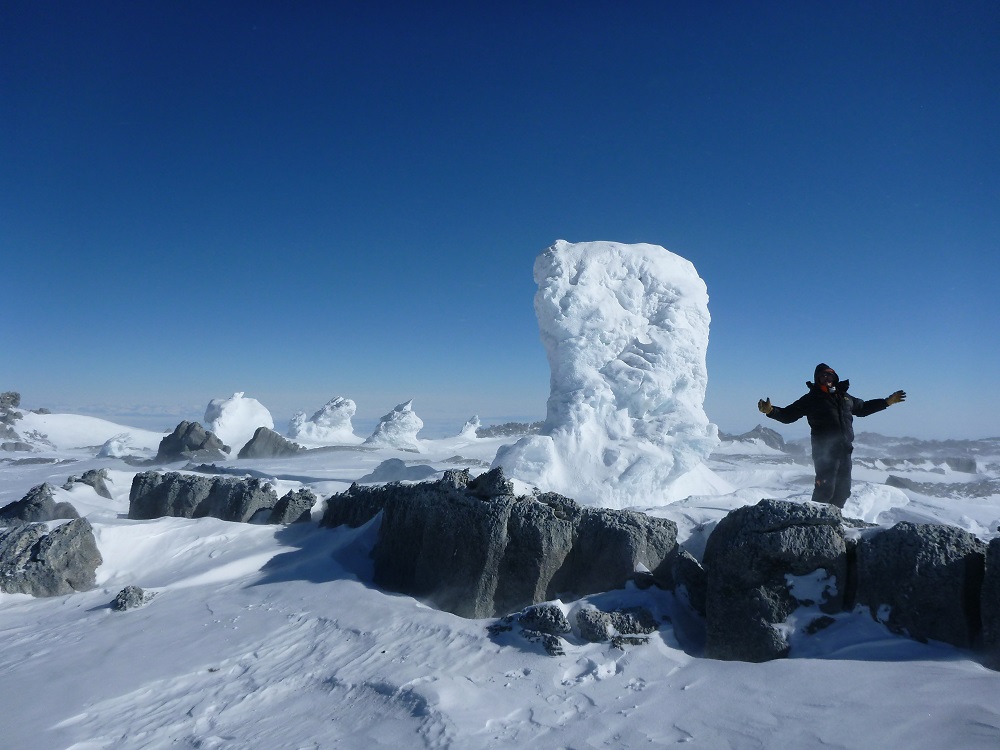
Ice fumerole on mount erebus volcano

Our route from LEH to Fang Glacier camp

We landed at Lower Erebus Hut (LEH) 3402m. This is a permanent camp used by scientists with the US Antarctic Program (USAP) and is home to the Mount Erebus volcano observatory (MEVO). There is standard route marked with bamboo wands between LEH and Fang Glacier Camp that we followed. The route is not particularly steep or dangerous, and can be followed by experienced people on snow mobiles. Fang Glacier Camp where we finished our exercise is situated at about 2800m and is often used as a place for people to acclimatize before moving up to LEH.


Technical Search and Rescue

Search and rescue has many different aspects and facets to it, especially in Antarctica where the terrain can extreme and hostile. On this trip we were practicing our technical rope rescue skills, which we would employ in order to get injured people out of steep and difficult terrain. Similar techniques to the ones we were using have been used several times in Antarctica to recover people/bodies from crevasses. Erebus, although not very steep, was a great training ground for us to practice lowering a stretcher and attendant down a slope. This situation could play out in real life if someone was injured halfway down a steep slope and we were unable to access the slope directly by helicopter. The photo below shows myself training for crevasse extraction in New Zealand.

Search and rescue stretcher training crevasse extraction

Antarctica : A Journey Over and Under the Sea Ice

Hagglunds driving on sea ice between massive icebergs in Antarctica

Join us in Antarctica as we drive across a frozen sea between huge icebergs to set up a diving camp


Why we had "stashed our cargo sleds"

Weather has the final say on how we do things down in Antarctica. We were planning to set off on the trip a couple of days earlier, but there was some particularly bad weather on it's way. We decided to get a start, and rather than enduring the storm in our tents we left the D6 bulldozer with the sleds and headed back to Scott Base in the much faster Hagglund. The image below has not been photoshopped and is representative of the "inside of a ping-pong ball" conditions we had on that day.
D6 Bulldozer pulls cargo sleds in white out conditions in Antarctica

What I REALLY actually do in Antarctica

matt windsor ice beard scott base
I work for Antarctica New Zealand as a field training instructor. This job does occasionally involve hard physical work such as moving large quantities of snow (as shown in the video), but it is generally characterized by providing training for scientists and providing safety support for their projects in the field. On this trip to Granite Harbour I was sharing the responsibility of assuring safe travel which involved choosing a route across the ice and identifying and measuring the cracks. I DO get to do some (relatively tame) kite skiing and snowmobiling, although the kiting/snowmobiling clips are not of me or even filmed in Antarctica.

Travelling across Antarctic sea ice

The ocean freezes over in McMurdo Sound Antarctica during winter and often breaks out by late summer. We did this trip in early summer (October) when the sea ice was still firm, cold and almost 2 meters thick (thick enough to safely land a Boeing 757 passenger jet). The map below is the shows the route from Scott Base to our destination at Granite Harbour. For some more aerial footage of the surrounding area, check out our page on the McMurdo Dry Valleys.


Cracks in the ice

One of the biggest hazards of driving over sea ice in Antarctica is large cracks caused by ice movement due to weather and ocean activity. The most dangerous of these are spreading cracks that widen and refreeze over time producing a crack with a profile shown in the diagram, that can then be hidden by snow. For the hagglund we can cross an effective crack width (W) of 75cm wide where the ice thickness is less than 70cm (T). The D6 bulldozer can cross a crack of up to 1.2m wide but we need a ice thickness of at least 1m on either side. These values are very conservative to enable a large margin of safety for operating in such an extreme and remote environment.
Spreading crack sea ice antarctica open sea ice crack mcmurdo sound antarctica


Camping in Antarctica

To ensure a successful 3 week antarctic diving expedition, life needs to be as comfortable as is reasonable. Divers need to be kept warm, hydrated, fed and well rested. Each team member has their own Scott polar tent complete with double Thermorest, sheepskin mat and -40 degree double sleeping bag system. The living/kitchen tent has a gas powered stove/oven, fireplace, and even AC/DC electricity supplied by the generator. Dive tents have electricity to run the science equipment, and gas heating to help the divers with the cold and also to keep the dive holes from refreezing.

Diving Camp on Sea Ice in Granite Harbour Antarctica

How to pitch a tent on hard ice

During the sped up "setting up the dive camp" video scene I show a clip of drilling and tying a V-thread. This is an incredibly strong anchor that also has many mountaineering and ice climbing applications. It is made by drilling to intersecting holes in the ice to make a V shape that is then threaded with rope.
Example diagram drawing of a v-thread in ice Scott polar tent v-thread example on hard sea ice in Antarctica

Making a dive hole

The most difficult aspect of making a dive hole in Antarctica is the fact that the ice is so thick (up to 2m). The first layers of ice can be cut through with a chainsaw, but eventually you need to puncture through to the water below and then have to somehow remove the ice at the bottom of the hole which is now completely submerged. To melt this ice into blocks we use a pump to suck sea water out of the hole, heat it up and then direct it back into the hole using metal tubing. In the time-lapse clip on the video you will see the tubing is first a square shape and then just a single bar. This arrangement melts the ice into blocks that float to the surface and can be removed.
making an ice diving hole in antarctica using a hole melter melting a sea ice diving hole in granite harbour

SCUBA diving in Antarctica

SCUBA diving in such an extreme environment obviously has it's challenges. Firstly the water is a chilly -1.8 degrees C (28.8 F) which takes it's toll on the body and requires adequate systems and equipment to prevent hypothermia. Secondly the only place you can exit the water is the 2m square hole in the ice where you entered. This means that tethering divers with ropes, using good communication and having self sufficient rescue plans are vital to a safe and successful diving operation. All of the diving footage on the video is used with permission from Peter Marriot and NIWA. To see more of this footage and explanations of the science check out NIWA's videos Thin Ice and Ice Divers.
scuba diving under ice in antarctica

Antarctic science and global warming

Antarctica is the last region on earth to be discovered by humans. While being the coldest, driest and windiest continent it is also home to 61% of all the worlds fresh water locked up in it's ice cap. If it were to all melt this would represent a 58m rise in global sea levels. At least 30 different countries operate research stations on the continent and do so under guidance of the Antarctic Treaty. They study many things, but some of the most important studies relate to how global warming will affect both the ecosystem there, and the rate of ice loss and melting which will affect the entire planet. I support scientists by helping them directly in the field, but I also support them by sharing my images and experiences with you so that it may help you to appreciate what people are doing down in Antarctica and it's importance on a global scale.

An Antarctic Oasis - The McMurdo Dry Valleys

The McMurdo Dry Valleys in Antarctica are one of the worlds most extreme deserts and are said to have an environment closer to that of the planet Mars than any other place on earth. With a rocky and barren landscape battered by extreme katabatic winds, the dry valleys provide an interesting if not hostile backdrop for many science projects over the antarctic summer.

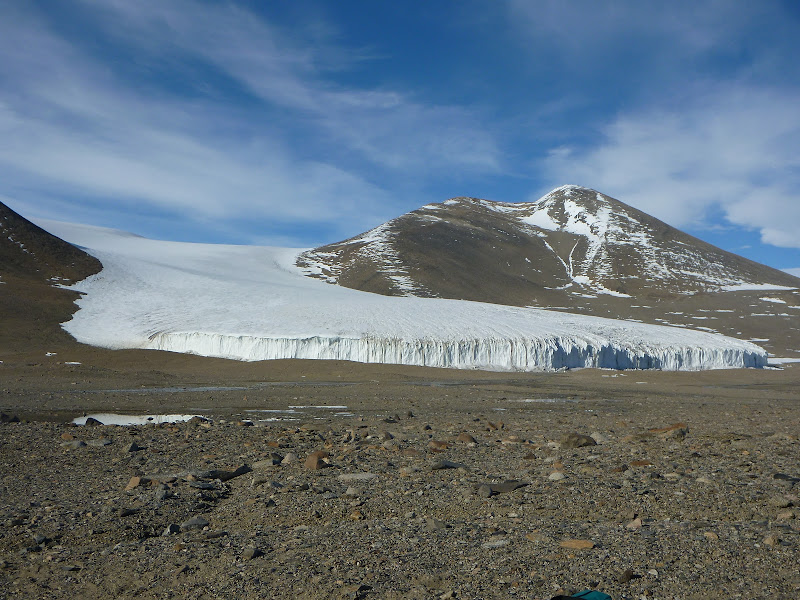
Glacier Taylor Valley McMurdo Dry Valleys

Glaciers and Rock

I have been lucky enough to visit the dry valleys on 3 occasions where I have captured images of the valleys during different conditions. The photo above shows the contrast between a teardrop shaped glacier and the dry rocky ground. My video below shows spectacular helicopter footage of the Dry Valleys during a rare moment when there is "lots" of snow on the ground, and the glaciers are less distinguishable:


Antartic Dry Valleys by Helicoper


This video was shot while conducting maintenance on Antarctica New Zealand's three radio repeater sites. These sites are used to relay radio communications between science teams operating in the Dry Valleys and the Antarctica New Zealand base on Ross Island. Because it was early in the summer season the temperatures were rather cold with wind chills at Mt Mule getting below -40C (also -40F)

Map of the Dry Valleys


A satellite view of the McMurdo Dry valleys, the McMurdo Sound and Ross Island along with the route of the helicopter and locations of the radio repeater sites. It is worth zooming in to the Dry Valleys and exploring the martian-like landscape.

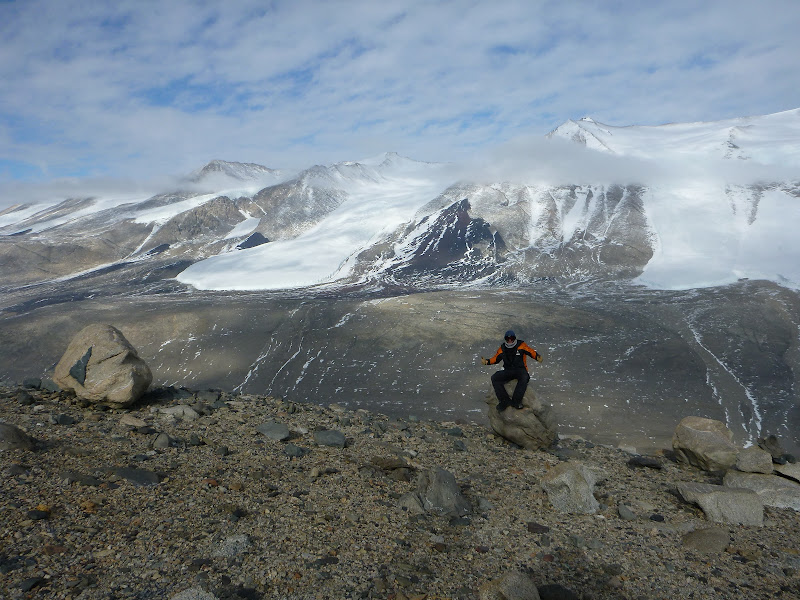
Taylor Valley McMurdo Dry Valleys
Me sitting on a rock at the JJ Thomson site (start of the video) with the glaciers coming down into Taylor valley in the background.

mummified weddell seal mcmurdo dry valleys

Mummified weddell seals


This photo shows one of the famous mummified weddell seals of the Dry Valleys. There are apparently hundreds of specimens that have crawled up to 41 miles inland and to elevations up to 5,900 feet above see level. Why these seals have wandered so far from the ocean has remained a mystery.


wildlife of antarctica
Spectacular images and videos of Antarctic animals.

Penguins in Antarctica

three adelie penguins on the antarctic pack ice
Of 17 species of penguins found in the world, only 6 are found in Antarctica. Of those 6 species, only 2 are found as far south as the McMurdo Sound where Scott Base and McMurdo Station are located: The adelie penguin and the Emperor Penguin.

Adelie Penguins

Penguins are the most anthropomorphic of all birds - and Adelies in my opinion are cutest and most comical of penguins! They are relatively small penguins averaging 70cm (27.5in) high and weighing 5kg (11pounds). These penguins are quite curious and will come right up beside you to see what you are doing. My video below was filmed at the edge of the sea ice while I was with scientists studying killer whales.


Emperor Penguins

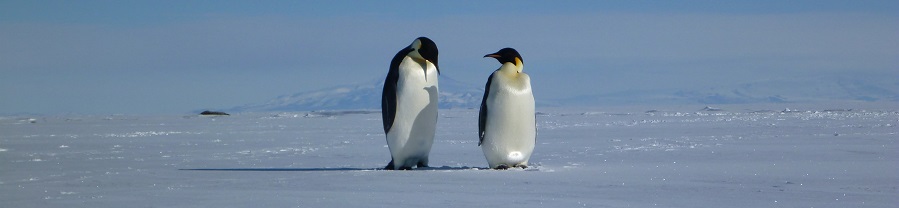
Emperor penguins are the largest and most "majestic" of penguins. They average 1.15 meters (44in) and 30kg (66pounds) in weight. The emperor penguins are currently listed as near threatened by the IUCN, and is currently under consideration for inclusion under the US Endangered Species Act. The main risks of to this species is declining food availability due to the effects of climate change and industrial fisheries.

2 emperor penguins on snow
I recorded the video below while out on the Antarctic sea ice in McMurdo Sound. In the first frame you can see Mt Erebus in the background. In the second frame you have the Trans-Antarctic Mountain Range which includes Mt Discovery. The third frame shows the Barne Glacier, and in the last you can see the Ross Island Peninsula with Tent Island to the right.


This Page is still under construction. For more videos and information on penguins please visit the links below. Thank you!


how do penguins stand up
Penguins have long bodies and short stumpy legs. How do they get back up after falling over?


how do penguins mate
Catch a sneak peek at how the birds do it